- DMS
- 898 Views
Why Tabletop Training Is Essential for Modern Emergency Preparedness
- | 0 Comments
Why Tabletop Training Is Essential for Modern Emergency Preparedness
When an emergency occurs, responders rely on more than equipment and protocols - they rely on planning, communication, and experience developed long before the incident begins.
Whether responding to a mass casualty incident, active threat, hazardous materials release, hospital surge event, natural disaster, or a large public gathering, agencies that have trained together consistently perform better under pressure than those meeting for the first time during an emergency.
That's why tabletop exercises have become one of the most valuable tools available for emergency managers, hospitals, fire departments, EMS agencies, law enforcement, Emergency Operations Centers (EOCs), healthcare coalitions, schools, and public safety organizations.
Unlike lectures or classroom presentations, tabletop exercises place participants into realistic scenarios where they must think critically, communicate effectively, coordinate resources, and make decisions together - all within a controlled learning environment.
As emergency incidents continue to grow in complexity, collaborative planning has become just as important as operational response.
Why Tabletop Exercises Matter
Emergency incidents rarely unfold exactly as planned. Resources become unavailable, new information changes priorities, weather affects operations, and staffing can shift over the course of an extended response. Tabletop exercises allow agencies to work through these variables before they occur in real life.
Tabletop exercises provide an opportunity to identify these challenges before they occur during an actual emergency.
Rather than testing field operations alone, tabletop exercises allow agencies to evaluate decision-making, communication, coordination, operational plans, and the tools that support emergency response. Participants discuss evolving situations, assign responsibilities, review available resources, and identify opportunities for improvement before an actual incident occurs.
These discussions strengthen emergency plans while building confidence among responders, command staff, and organizational leadership.
Building Unified Command Before It Matters
Successful incident management depends upon coordinated decision-making across multiple organizations.
Fire & EMS.
Law Enforcement.
Emergency Management.
Hospitals.
Public Health.
Emergency Operations Centers.
School Districts.
Private Industry.
Volunteer Organizations.
Each organization brings different responsibilities to an incident, yet all must work together under a common operational picture.
Tabletop exercises create an environment where agencies can practice Unified Command, clarify responsibilities, evaluate communication pathways, establish resource priorities, and strengthen coordination before an emergency requires them.
The result is greater operational efficiency, improved communication, and stronger relationships between agencies that may only work together during major incidents.
Planning Beyond the Initial Response
The initial response is only one phase of an incident. As operations expand, agencies must coordinate patient movement, resource requests, hospital capacity, public information, and incident command across multiple organizations.
As incidents evolve, agencies must also consider:
- Resource deployment
- Mutual aid coordination
- Patient transportation
- Hospital surge capacity
- Evacuation operations
- Family reunification
- Public information
- Emergency Operations Center activation
- Recovery planning
Walking through these operational phases during tabletop exercises allows participants to understand how decisions made early in an incident can affect operations hours - or even days later.
Enhancing Traditional Tabletop Exercises with Digital Collaboration
Traditional tabletop exercises have long relied on printed maps, dry-erase boards, and face-to-face discussion to strengthen emergency preparedness.
These proven methods remain an essential part of emergency planning.
Today's agencies, however, are also looking for ways to improve collaboration, organize information more efficiently, and build exercises that can evolve alongside their emergency plans.
That's where SimTac City® bridges the gap between traditional tabletop training and modern digital preparedness.
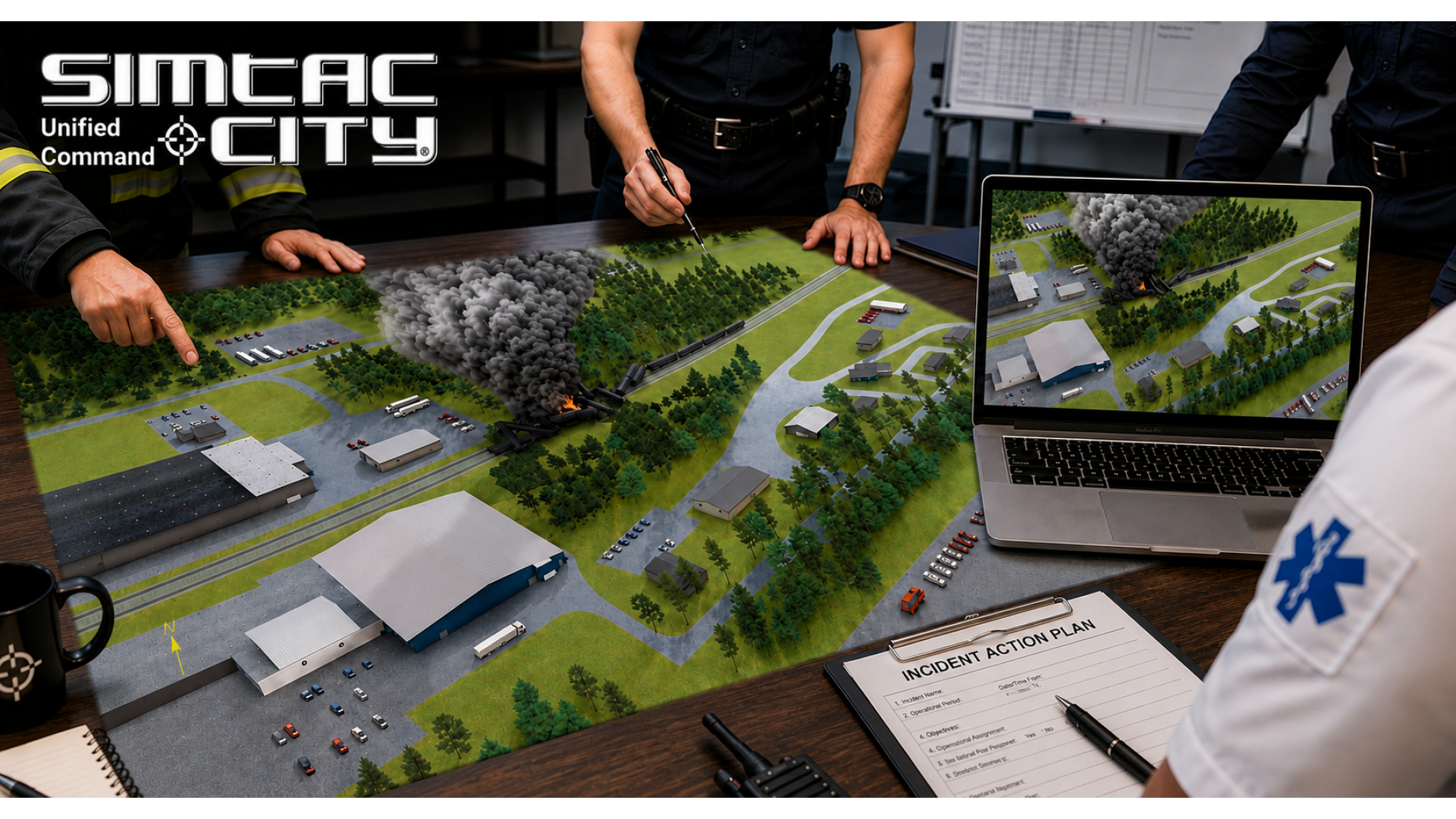
By combining detailed physical tabletop maps with an interactive digital platform, SimTac City allows agencies to conduct realistic emergency planning exercises while organizing resources, documenting decisions, saving exercise data, and collaborating across multiple departments.
Whether planning security for a football stadium, conducting a hospital evacuation exercise, preparing for hurricane season, or coordinating a regional mass casualty response, tabletop exercises give agencies an opportunity to test plans before they're needed.
SimTac City enhances traditional tabletop exercises by bringing physical planning materials and digital collaboration together in a single, flexible training environment.
New Features Designed for Better Collaboration
Preparedness is rarely accomplished by one individual.
Planning requires participation from multiple departments, subject matter experts, leadership teams, and partner agencies.
Recent enhancements to SimTac City were designed specifically to improve collaboration before, during, and after tabletop exercises.
New platform features include:
- Save frequently used resources as Favorites for faster exercise setup.
- Open multiple planning tabs simultaneously.
- Invite multiple users to collaborate within the same digital environment.
- Continue receiving future software enhancements as part of your one-time purchase.
These capabilities make it easier for organizations to develop emergency plans, conduct collaborative exercises, review after-action improvements, and continuously strengthen preparedness programs.
Supporting Every Stage of Emergency Preparedness
Emergency preparedness is an ongoing process - not a one-time event.
Organizations use SimTac City to support a wide range of planning and training activities, including:
- Emergency Response Planning
- Tabletop Exercises
- Unified Command Training
- Emergency Operations Center Planning
- Hospital Coordination
- Active Threat Preparedness
- Mass Casualty Incident Planning
- Large Event Pre-Planning
- After-Action Reviews
- New Personnel Orientation
- Multi-Agency Coordination
Because exercises can be saved, modified, and expanded over time, organizations can continue building upon previous training rather than starting from scratch with every new exercise.
A Platform That Continues to Grow
One of the greatest advantages of digital preparedness is the ability to evolve alongside your organization.
As facilities expand, emergency plans are updated, personnel change, and new threats emerge, SimTac City provides a flexible platform that can adapt with your preparedness program.
Existing customers automatically receive access to new platform enhancements as part of their original one-time purchase, ensuring organizations continue benefiting from future improvements without recurring software subscription costs.
Prepare Before the Emergency Begins
The strongest emergency responses are built long before an incident occurs.
Organizations that train together on a regular basis are generally better prepared to communicate, coordinate resources, and make informed operational decisions when an emergency occurs.
Tabletop exercises provide an opportunity to strengthen those capabilities within a realistic, collaborative environment where agencies can evaluate plans, refine procedures, improve coordination, and strengthen relationships before an emergency unfolds.
Whether your organization is preparing for an active threat, mass casualty incident, hospital evacuation, planned special event, or community-wide emergency, investing in collaborative training today helps build a more confident and coordinated response tomorrow.
SimTac City® was developed to support organizations as they plan, conduct, and refine tabletop exercises through a collaborative training environment that combines traditional tabletop planning with modern digital tools.
Ready to Experience SimTac City®?
Whether you're preparing for a mass casualty incident, planning a large public event, coordinating hospital response, or strengthening Unified Command, SimTac City provides an innovative approach to collaborative emergency preparedness.
Request a complimentary 10-day trial or schedule a live online demonstration to see how SimTac City can support your organization's emergency planning and training initiatives.
Explore SimTac City®
https://www.triagetags.com/Sim-Tac-City
Related Product
SimTac City® Tabletop Training Kit
SimTac City® Tabletop Training Kit Tabletop Tactics Simulation & Application Kit for Unifie..