- DMS
- 112 Views
From Venue Operations to Hospital Surge: Preparing for the Entire Incident
- Mass Casualty Response
- | 0 Comments
From Venue Operations to Hospital Surge: Preparing for the Entire Incident
Large public events require extensive planning long before attendees arrive. Whether supporting a sporting championship, concert, festival, political convention, marathon, or other large-scale gathering, response organizations must prepare for far more than what occurs inside the venue itself.
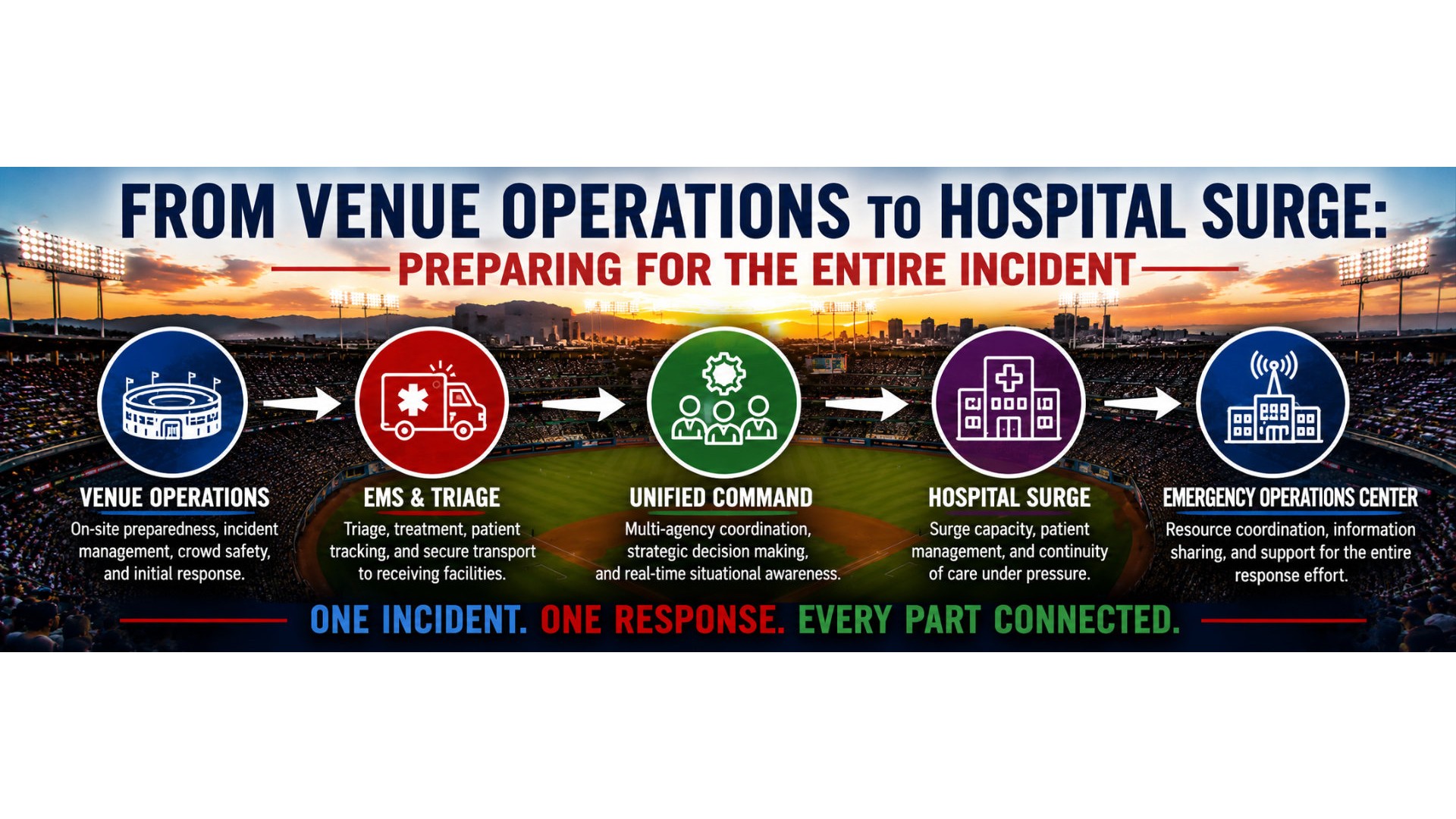
Successful major event preparedness extends beyond crowd management and security planning. It requires a coordinated approach that addresses venue operations, emergency medical response, patient management, hospital surge capacity, unified command, and emergency operations center (EOC) coordination.
When an incident occurs, the response does not stop at the venue gate. Patients move to treatment areas and receiving facilities. Information flows between responders, hospitals, emergency managers, and government agencies. Resources must be tracked and coordinated across multiple organizations. Decisions made during the first few minutes often influence operations for hours or even days afterward.
Organizations that plan for the entire incident lifecycle are better positioned to protect attendees, support responders, and maintain operational continuity during complex events.
Major Events Create Unique Operational Challenges
Unlike day-to-day emergency incidents, major public events concentrate large numbers of people into a single location. This creates unique planning considerations that require collaboration between multiple disciplines.
Potential challenges may include:
- Medical emergencies
- Mass casualty incidents
- Severe weather
- Crowd surges
- Infrastructure failures
- Transportation disruptions
- Security incidents
- Hazardous materials events
- Public health concerns
While the likelihood of any specific event may be low, the consequences can be significant. As a result, preparedness efforts must focus not only on prevention but also on coordinated response capabilities.
The most effective preparedness programs recognize that venue operations, medical response, hospital readiness, and command coordination are all interconnected components of a larger system.
Venue Operations: Establishing Control at the Point of Impact
The first phase of any major incident typically begins at the venue level.
During the initial minutes of an incident, responders must quickly establish situational awareness, assess hazards, organize resources, and begin managing affected individuals.
Critical objectives often include:
- Initial patient categorization
- Treatment area establishment
- Resource accountability
- Incident command activation
- Scene organization
- Crowd management
- Transportation coordination
The ability to rapidly organize these functions can significantly influence downstream operations.
Many organizations are now adopting dedicated venue-level preparedness kits that combine triage resources, command tools, and accountability systems into a single operational package.
The DMS Core Venue Kit Series was developed to support this phase of response by providing resources for initial triage, command coordination, and patient management at the point of impact.
Recommended Resource:
➡ Core Venue Kit Series
Initial Triage Is Only the Beginning
One of the most common misconceptions in major event planning is that triage represents the primary medical challenge.
In reality, triage is often the easiest part of the process.
The greater challenge involves maintaining accountability and situational awareness as patients move through the system.
Questions quickly emerge:
- How many patients have been identified?
- Which acuity levels are represented?
- Where are patients being treated?
- Which hospitals are receiving patients?
- How many transport resources remain available?
- Have all patients been accounted for?
Without established systems and procedures, valuable information can be lost as operational complexity increases.
This is why many agencies are shifting toward preparedness programs that integrate triage, patient tracking, treatment management, and transportation coordination into a unified operational process.
Hospital Surge Planning Must Be Part of the Conversation
Major event preparedness frequently focuses on venue operations while giving less attention to what occurs after patients leave the scene.
However, hospitals often experience some of the greatest operational impacts following a large-scale incident.
Receiving facilities may encounter:
- Sudden increases in patient volume
- Self-transporting patients
- Family reunification challenges
- Resource shortages
- Staffing demands
- Information management requirements
- Extended operational periods
Many hospitals maintain Hospital Incident Command System (HICS) structures specifically designed to support these situations.
Integrating healthcare facilities into preparedness planning before an event allows responders and receiving facilities to establish common expectations and communication pathways.
The DMS Medical Surge Kit Series was developed to support receiving facilities and healthcare systems during elevated patient volumes by providing tools aligned with patient management and hospital command functions.
Recommended Resource:
➡ Medical Surge Kit Series
Unified Command Requires a Common Operating Picture
As incidents grow in complexity, decision-making expands beyond field operations.
Multiple agencies may need to coordinate objectives, share information, allocate resources, and establish priorities through unified command structures.
This process depends on maintaining a common operating picture.
Without a common operating picture, agencies may develop different understandings of:
- Incident status
- Resource availability
- Patient counts
- Operational priorities
- Response objectives
The result can be duplicated efforts, delayed decisions, and reduced situational awareness.
Whether utilizing traditional command boards, digital systems, or a combination of both, the objective remains the same: ensuring decision-makers have access to accurate and actionable information.
Emergency Operations Centers Extend Coordination Beyond the Scene
Large-scale events often require coordination that extends beyond incident command.
Emergency Operations Centers support this broader coordination effort by facilitating:
- Multi-agency collaboration
- Resource requests
- Regional situational awareness
- Executive decision-making
- Public information coordination
- Long-term operational support
While venue operations may focus on tactical objectives, EOCs help manage strategic considerations that affect the wider community.
For many jurisdictions, establishing EOC readiness before a major event is an essential component of preparedness planning.
The DMS Unified Operations Center Kit was designed to support these activities through EOC-focused command boards, visual management tools, and coordination resources.
Recommended Resource:
➡ Unified Operations Center Kit
Training and Exercises Validate Preparedness Plans
Preparedness is not determined by the existence of a plan.
It is determined by an organization's ability to execute that plan under pressure.
Tabletop exercises, functional exercises, and interdisciplinary training programs allow agencies to:
- Validate procedures
- Identify planning gaps
- Improve interoperability
- Strengthen communication pathways
- Build familiarity with command structures
- Enhance decision-making processes
The most successful major event responses are typically supported by months of planning, training, and exercise activities.
Organizations that regularly train together are often better prepared to coordinate during real-world incidents.
To support these efforts, DMS developed the Training & Exercise Kit Series, which combines tabletop simulation resources, digital command tools, patient scenarios, and triage training systems designed specifically for multi-agency preparedness programs.
Recommended Resource:
➡ Training & Exercise Kit Series
Preparing for the Entire Incident
The most successful major event responses are rarely the result of a single tool, agency, or plan. They are the result of coordinated preparation across multiple organizations that understand how their roles connect throughout the response lifecycle.
From venue operations and patient management to hospital surge, unified command, and emergency operations center coordination, preparedness must extend beyond the first few minutes of an incident.
The DMS Major Event Readiness Packages were developed around this philosophy—providing interoperable preparedness solutions that support response across every phase of a major event.
Whether preparing for a large sporting event, festival, NSSE, convention, or other mass gathering, organizations that plan for the entire incident are better positioned to respond effectively when it matters most.
Related Product
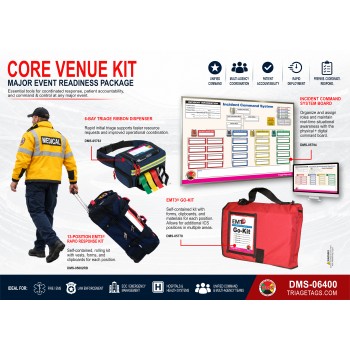
Core Venue Kit Series
Core Venue Kit Series The Core Venue Kit Series is designed to support organized response opera..
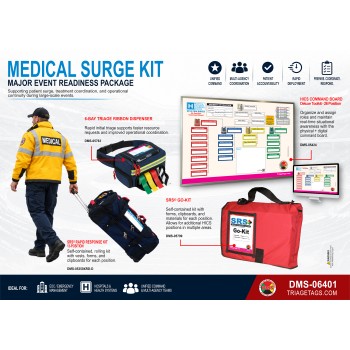
Medical Surge Kit Series
Medical Surge Kit Series The Medical Surge Kit Series is designed to support hospitals, receiving..
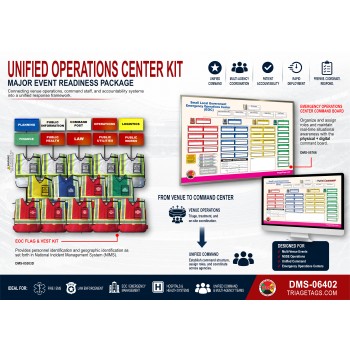
Unified Operations Center Kit
Unified Operations Center Kit The Unified Operations Center Kit is designed to help agencies es..
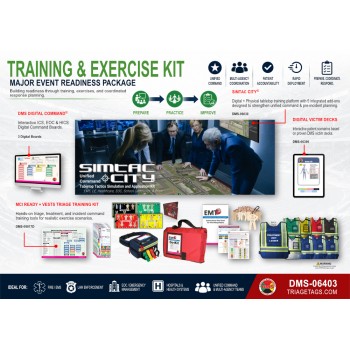
Training & Exercise Kit Series
Training & Exercise Kit Series The Training & Exercise Kit Series helps agencies prepar..