- DMS
- 392 Views
Improving Patient Accountability During Mass Casualty Incidents
- Mass Casualty Response
- | 0 Comments
Improving Patient Accountability During Mass Casualty Incidents
Mass casualty incidents demand rapid decision-making, clear communication, and coordinated response across multiple agencies. While responders train extensively in triage protocols such as START or SALT, after-action reports consistently reveal a recurring challenge:
Maintaining patient accountability from triage through transport.
In the early minutes of a major incident, responders often perform triage effectively. The breakdown typically occurs later - when patients begin moving through treatment areas and toward transport.
Without a structured system in place, critical patient information can quickly become fragmented.
The Patient Accountability Challenge in Mass Casualty Incidents
During a large-scale incident, responders must simultaneously:
- Identify and triage patients
- Document patient conditions
- Track treatments provided
- Coordinate ambulance transport
- Record hospital destinations
- Maintain accountability across multiple operational areas
While triage systems provide an initial method for categorizing patients, responders frequently encounter challenges once patients begin moving toward treatment and transport areas.
Common accountability issues include:
- Missing or incomplete patient documentation
- Ambulance destinations not recorded
- Difficulty matching patients to transport units
- Limited visibility for command staff on patient movement
- Breakdowns between triage, treatment, and transport teams
These gaps can create confusion during the incident and complicate medical continuity after the event.
Initial Triage: Speed and Patient Counts
During the initial triage phase, speed is critical. Responders must rapidly categorize patients and move them toward appropriate treatment areas.
To support this process, many agencies utilize triage ribbons during initial triage. Ribbons allow responders to quickly identify patient priority categories while also supporting initial patient counts without slowing down the triage process.
This approach helps responders rapidly move through large patient groups while maintaining a visible triage categorization.
Applying Triage Tags in the Treatment Areas
Once patients arrive in designated treatment areas, responders can transition from rapid initial triage to more detailed patient documentation.
At this stage, All Risk® Triage Tags are commonly applied. These tags allow treatment personnel to document:
- Patient condition
- Vital signs
- Treatments provided
- Reassessments
- Patient identification
Applying triage tags in the treatment areas ensures that responders can capture critical patient information without delaying the initial triage process in the field.
This structured workflow supports both operational efficiency and accurate documentation during large-scale incidents.
Bridging the Gap Between Treatment and Transport
One of the most common breakdown points during mass casualty response occurs between treatment areas and ambulance loading zones.
As patients are prepared for transport, it becomes critical to maintain visibility of patient information and destination tracking.
The EMT3® System helps support this transition by providing structured transport documentation that records:
- Patient identification number
- Triage category
- Treatments provided
- Ambulance assignment
- Hospital destination
By linking treatment documentation with transport tracking, responders can maintain patient accountability as individuals move from the treatment area to ambulance transport.
This helps ensure that critical patient information stays with the patient throughout the response process.
Visual Accountability in the Field
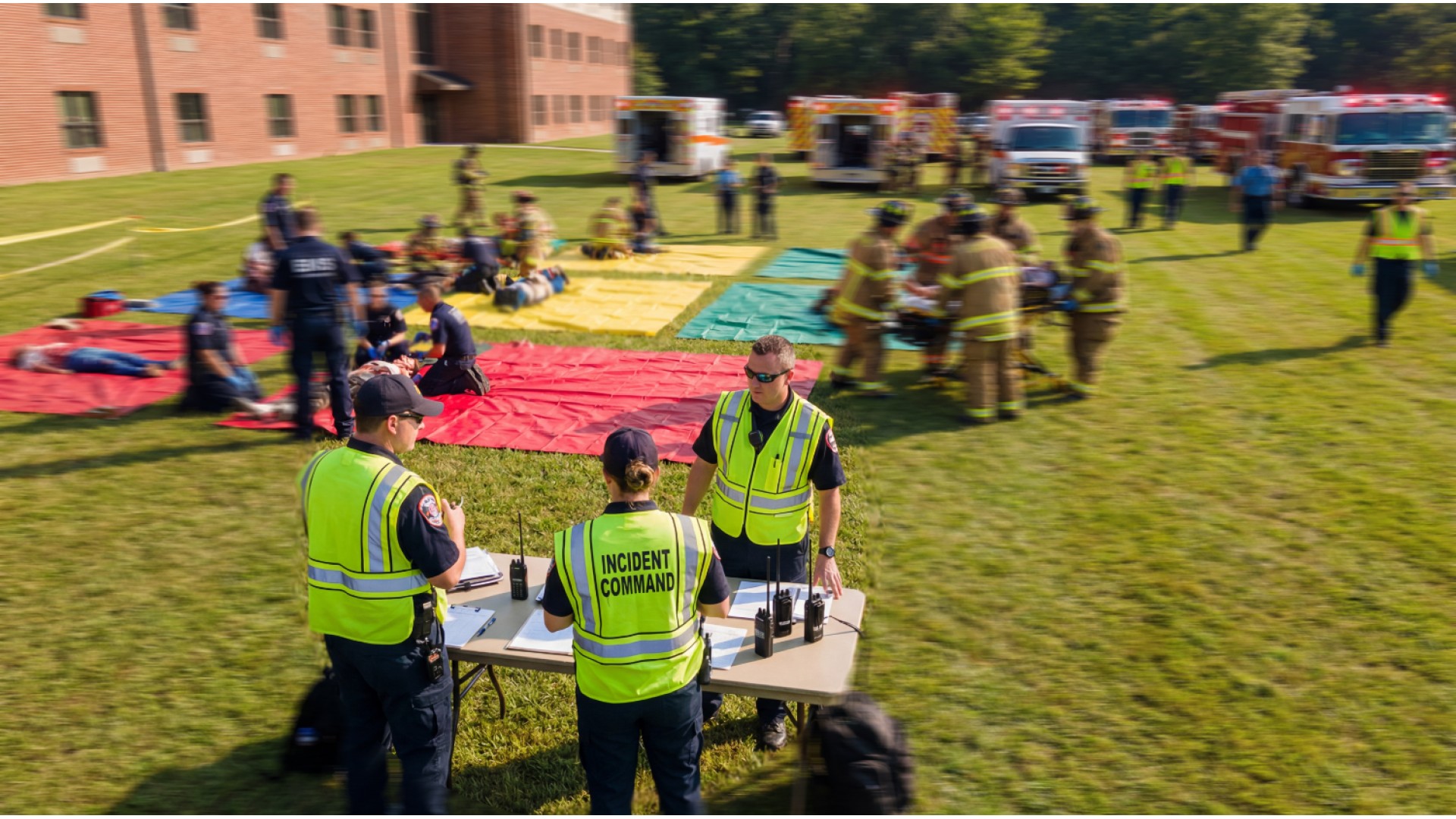
In addition to documentation systems, responders benefit from visual accountability tools that allow command staff to quickly assess the situation.
- Color-coded triage ribbons for initial triage
- All Risk® Triage Tags in treatment areas
- Position identification vests for operational clarity
These tools help responders maintain situational awareness and improve communication between operational units during complex incidents.
Training That Reflects Real Incidents
Preparedness also depends on realistic training environments.
- Mass casualty victim simulation decks
- Scenario-based tabletop exercises
- Incident command training tools
- Triage decision-making exercises
These training tools allow responders to practice triage, treatment, and patient tracking in a structured environment before facing a real emergency.
Preparedness Starts Before the Incident
One of the most important lessons learned from major incidents is that patient accountability systems cannot be improvised during a disaster.
- Pre-planned
- Standardized across agencies
- Practiced during training exercises
Organizations that implement structured triage workflows - from initial ribbon triage to treatment-area triage tags and transport tracking systems - are better prepared to maintain accountability during chaotic incidents.
From Chaos to Coordination
Mass casualty incidents will always involve complexity. However, complexity does not have to lead to confusion.
By combining rapid initial triage, structured treatment documentation, and coordinated transport tracking, agencies can transform the chaotic early moments of an incident into a coordinated response that saves lives.
Preparedness isn't just about having equipment available - it's about ensuring every patient remains accounted for from initial triage through final transport.